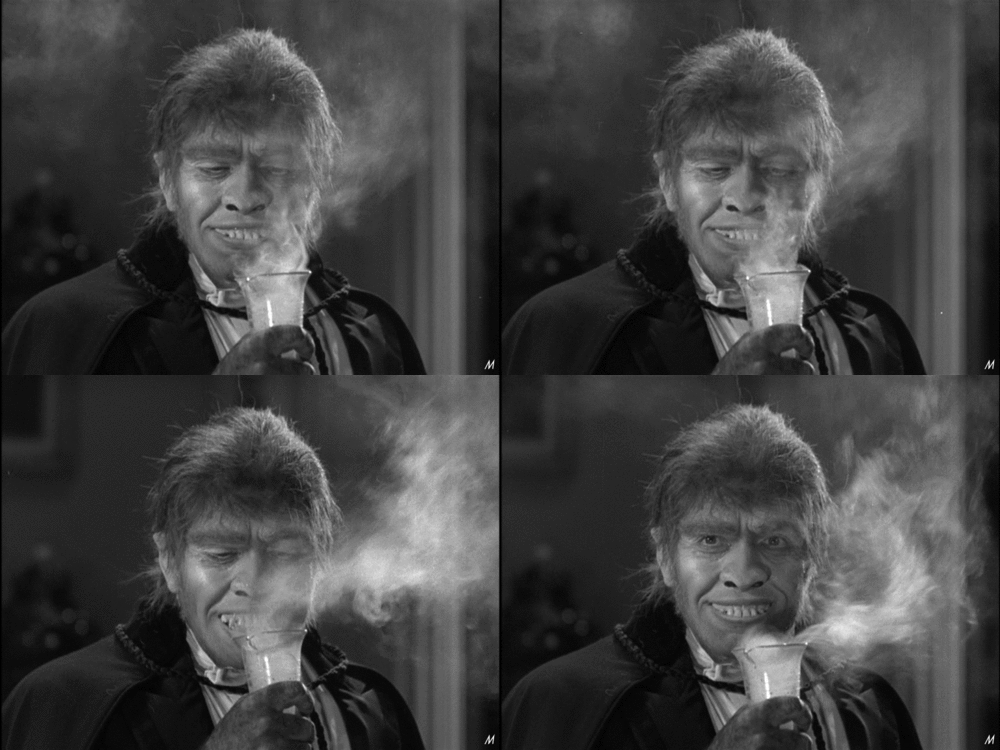
We all know the story of the good Doctor Jekyll and his doppelgänger the frightening M. Hyde. A doctor is tortured by the complexity of his personality so he decides to invent a cure that allows both personalities to split. A nice, friendly and empathetic doctor during the day, a terrifying and cruel creature at night.
This change of personality he has to go through to perform at work is the same senior leaders are experiencing, they are undergoing a transformation they often did not see coming. Big words such as disruption, start-ups, data, artificial intelligence… are everywhere, on everyone’s lips and they are altering markets as we know them every day at a very high pace.
In order to keep being efficient, they have to shut down their instincts: old leadership theories. You know, these well-established theories, neither creative nor flexible, very well suited for a strong hierarchical structure but desperately lacking reactivity and proactivity. They have to go against it thus creating a new being within their body: the modern flexible leader. The leader who knows how to lead in the dark without being eaten up by stress or fear of uncertainty. Now, old leadership theories will not murder sir Danvers Carrew but they might murder your company… I mean… negatively impact your company.
Let’s travel all the way from London’s 19th century back to the 21st century to see how our modern doctor Jekyll manages his M. Hyde. How do senior leaders create in themselves the modern leader, how do they reinvent themselves?
Like true scientists, business specialists have dissected the good and bad practices in companies like hypothesis to test and finally established what a doctor would call a medicinal potion but what businessmen call a methodology (in a few steps that, followed rigorously seems to give an answer as to how to manage a business in a constantly evolving world).

According to Sam Bourton in « Leading with inner agility », you can force yourself to be more flexible in decision making by following 5 steps:
1- Pause to move faster. Take a step back, take some time to look at the problem from afar.
2- Embrace your ignorance. Admit that you may not have been correct.
3- Radically reframe the questions. Look at your problem from another perspective.
4- Set direction, not destination. Set a course for yourself and your co-workers
5- Test your solution – and yourself. Fail, and fail again until you succeed.
Take a step back, accept that they are things you don’t know, look at the problem from another perspective, set a course and fail, again and again until you succeed. Keeping in mind every one of these steps is the foundation of inner agility allows leaders to address problems in a more agile manner without being stuck. By agreeing to the fact that sometimes, the force of the outer world is greater than theirs and that they have to be the reed in La Fontaine’s fable, not the strong rooted oak.
But the transformation has to go further than that. If you reach this point you haven’t quite created your doctor Jekyll yet. Leaders have to go through changes of personality, of behavior towards people, they have to be highly empathetic. Carin Watson in Driving Transformation in the Changing Global Business Landscape says “Exponential leaders are futurists, innovators, technologists, and humanitarians… ».
Once you have achieved inner peace, as a leader you need to be able to communicate it to your coworkers. What we often don’t realize when we ourselves are overwhelmed with the constant changes in the market, is that the people around us feel the same constant pressure and that they are looking at you to tell them it’s going to be fine. So you have to adopt an emotional management style. A great leader doesn’t have to be perfect, he has to be human and attainable. When referring to the case of an army general who kisses one of his wounded soldiers, in his Ted Talk “Why good leaders make you feel safe”, Simon Sinel says “In the army we give medals to people who are willing to sacrifice their live for the others, in business we give bonusses to people who are willing to sacrifice the others for our profit. We do it all backwards.” When he tries to understand why people are willing to sacrifice themselves, the answer he gets is always “Because they would have done it for me”. It shows the capacity of everyone to do amazing things if the leader is able to create trust and collaboration.
Creating this new leader in you is also the ability to accept that you are all in the same boat. The type of management has to be less hierarchical because your employees have to be able to feel close to you, they need to feel comfortable with telling you what’s on their mind. Creating this kind of trust allows your team to feel less scared towards uncertainty of innovation. So, the logic wants that the more innovative the innovation the more flexible the leaders. But is it really the case?
In “Product development as core competencies: how formal product development practices differ from radical, more innovative and incremental product innovation.” by Patricia J. Holahan, they tested many hypotheses on a sample of 380 business units managing different degrees of innovation to re-examine the role of control versus flexibility in management. The paper is a quantitative study of what really happens in companies. The first hypothesis: “higher levels of innovativeness will be associated with greater flexibility and less structured approach to NPD higher levels of innovativeness will be associated with greater flexibility and less structured approach to NPD” was unvalidated by the study. Meaning that amongst a big quantity of cross-organizational data, the more radical the innovation the less flexible the management process. The article also identifies two other things that are used in companies in order to drive innovation management: product champion to drive innovation, high senior management involvement. So, it does scientifically prove that the role of management is a very emotional approach but it also states that process has not to be overlooked. Managers cannot accept such flexibility as to allow anyone to do anything. They need some kind of structure and processes to lead their team in a foggy and uncertain environment. And this means establishing clear roles in the team. People can’t forget that you are the leader and even if hierarchy feels outdated, no hierarchy at all creates a climate of confusion and anxiety.

A good leader in a very unstable environment is someone who can find inner agility. It will allow him to gain self-confidence and to spread it amongst his co-workers. Once he has found this stabilization within his team he has to use emotional management technics in order to create a climate of trust while keeping a good sense of hierarchy.
Finally let’s say that the death of sir Danvers Carrew could have been avoided if only doctor Jekyll had realized that to be a good person you need to be a complex being.

References
Carin Watson, JANUARY 2019, Driving Transformation in the Changing Global Business Landscape, https://su.org/blog/driving-transformation-in-the-changing-global-business-landscape/
Tracy Lloyd, SEPTEMBER 2017, Business Transformation: How to Drive Successful Change,https://www.emotivebrand.com/business-transformation-change-management/
Simon Sinek, MARCH 2014, Why good leaders make you feel safe ?https://www.ted.com/talks/simon_sinek_why_good_leaders_make_you_feel_safe?language=ig#t-179438
Sam Bourton, Johanne Lavoie, Tiffany Vogel, MARCH 2018, https://www.mckinsey.com/business-functions/organization/our-insights/leading-with-inner-agility
 Rennes Business Review
Hi Lena,
At the end of your article, you say that leaders will gain ‘self confident and spread it among employees’, don’t you think that leaders have to be 100% confident in order to leader successfully? Through ‘leader’ don’t we mean also that he has to be sure and persuasive about its direction and vision?
J’aimeAimé par 1 personne
Hi,
Thank you for your question. The thing is that the world we’re leaving in is highly unstable. A leader used to be able to forecast and anticipate but it is getting harder and harder to do. He has to be sure of his vision and he has to be able to set a course but he cannot be 100% sure that he is not going to fail. See in a very competitive environment you have to be able to take risks too. When i say that a leader has to find confidence within himself in order to spread it amongst his team it’s also a way for him to be honest with his co-workers : if he tells them « We can’t know for sure, but i believe » than honesty is going to be a way of gaining trust and driving motivation.
I hope my answer will seem clear to you,
Thank you.
J’aimeJ’aime
Hi Léna,
Super article. I’ve also wrote an article of leadership capabilities, but from the junior (first-time) manager side. If you’re interesting in reading it, here is the link : https://managementofchange.home.blog/2019/03/12/leading-change-as-a-young-manager/
I think our 2 articles complete each other. Yet I have a question : do you think there is a limit to a senior’s ability to adapt to new technologies, processes etc..? what is your best recommandation in order to go through these limits ?
Thank you so much, have a great day!
Elise
J’aimeJ’aime
Hi Elise,
I read your article and it is great ! Very interesting. I did focus on senior manager but didn’t think about taking into account young blood 😉
I do believe that when you are a senior there is a limit to your understanding of the world. In my opinion, if you did not grow up with technology you might feel overwhelmed very quickly because as a senior you are often rooted in your habits. Yet i think there is a simple and attainable solution to break down these barriers :
How you say in your article, first admit you may be wrong then seek advice from people who know, i.e. young adults and milenials.
This requires big work on ego for senior managers i think. It would be interesting to investigate further though this relationship between young and seniors in the workplace !
J’aimeJ’aime
Hello Léna, very interesting article! I really appreciate your analogy with the story of Doctor Jekyll and M. Hyde. I’ve just read an article about the behaviors of Leaders who embrace change, I think it can nourish your work: https://hbr.org/2018/05/5-behaviors-of-leaders-who-embrace-change. 😃
J’aimeJ’aime