
Artificial Intelligence dates back to the 1950s however since few years we can see an explosion of the development of AI systems that revolutionize industries from agriculture or finance to health care.
A report from the consulting firm Frost & Sullivan points out that AI healthcare market will experience a compound annual growth rate of 40% through 2021 to reach $6,6 billion.
However, healthcare is far behind other industries when it comes to digitization that’s why the implementation of AI in this industry is an interesting case study that relieving many challenges. Furthermore, this industry is really complex and not really known by end users even if everyone will be affected by changes that will be caused by AI. (Jiang, 2017)
Artificial Intelligence is using algorithms to ‘learn’ features from a large volume of healthcare data and is using them to help assist the medical profession. It can help to reduce diagnostic and errors that are inevitable in the human clinical practice.
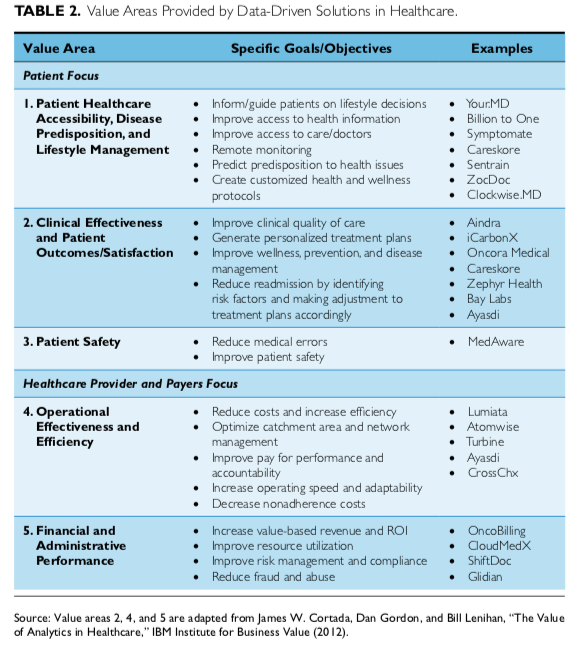
We can say that the implementation of AI in the healthcare industry will benefit everyone and we can identify two types of value creation:
For patients and their families:
– Patient health care accessibility
– Patient satisfaction
– Patient safety
For health care providers:
– Operational effectiveness and efficiency
– Costs reduction
– Administrative performance.
HOW AI WILL AFFECT HEALTHCARE INDUSTRY?
Digital consultations
In France there is a real issue of “missing doctors”. In 2018 we counted more than 11 000 municipalities classified as territories marked by a medical shortage. AI can compensate for this issue with chatbots, remote X-ray or digital innovations such as telemedicine which can replace doctors where they would be lacking. (Millet, Institut Montaigne, 2019)
Radiology and images
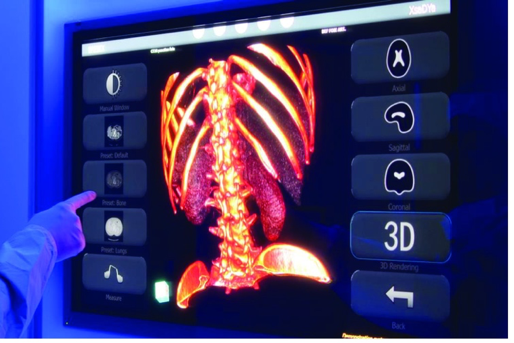
The best AI system to detect breast cancer is French! Therapixel provides an effective solution to the control of images in a sterile environment without touching. (Gouritin, 2017)
Robot surgeons
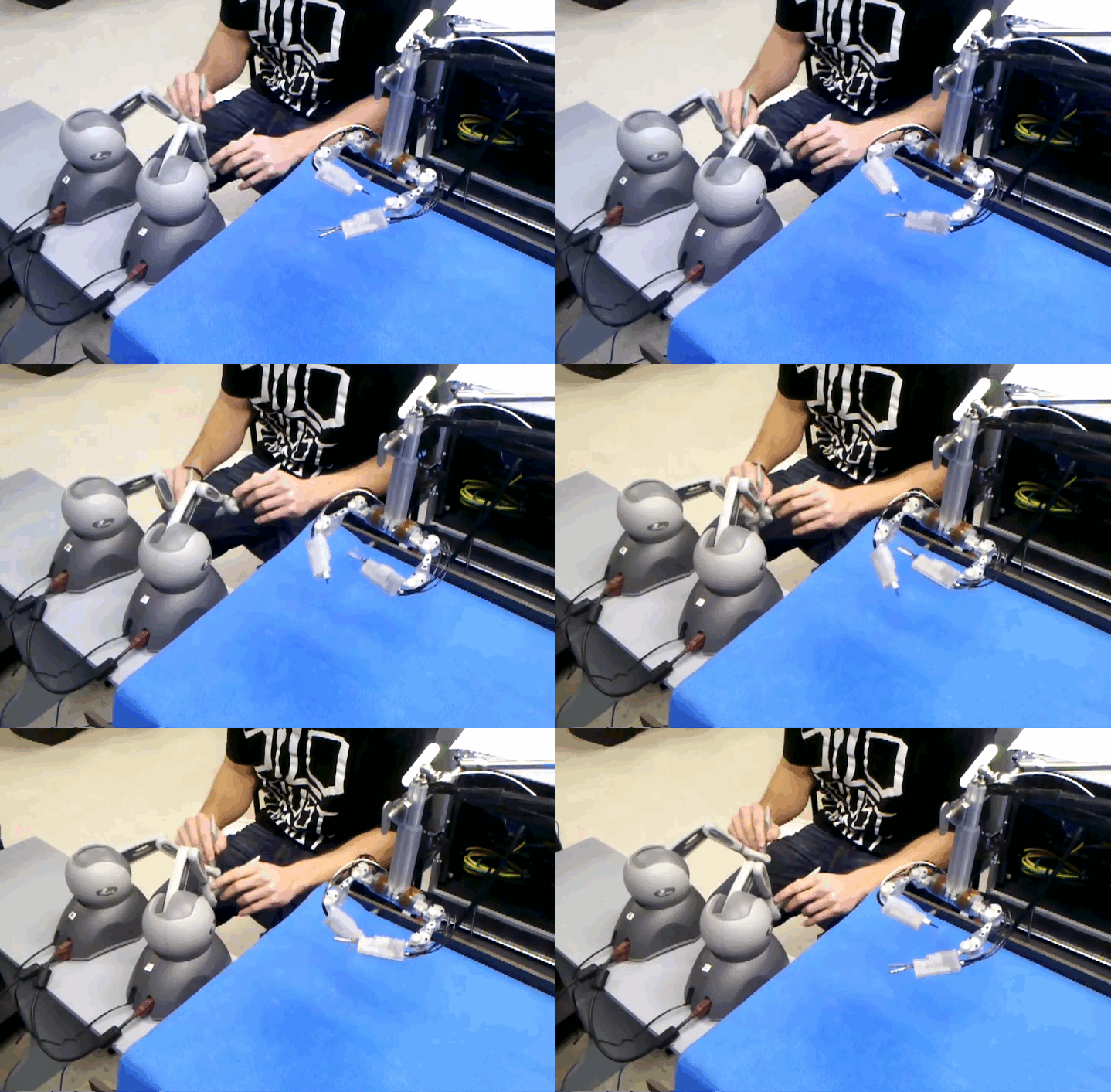
Microsurgery is very complex so AI can assist surgeons with this kind of operations.
For example, in fall of 2017, Maastricht University Medical Center in the Netherlands used an AI-assisted surgery robot to suture small blood vessels. The robotic system is controlled by a surgeon, whose hand movements are converted into smaller, more precise movements that are performed by a set of “robot hands.”
Cybersecurity
AI solutions need to be connected to internet, but it can be risky in term of security because hospitals can be hacked. To avoid this risk, hospitals need to implement Advanced cybersecurity solutions, this system will use machine learning to block all anomalous activities that could indicate any attacks.
WHY AI SHOULD BE IMPLEMENTED IN THE HEALTHCARE INDUSTRY?
Give a support to medical professionals:
– AI will assist medical professionals to make better clinical decisions. For example, in the radiology sector, an AI system has been developed with computer vision technology to look at x-rays or other scans the results which can then be sent to a doctor for to double-check. The results giving patients the best of both worlds: AI and a doctor together. (Nwazor, 2018)
– Diagnostic errors play a role in around 10 percent of patient deaths. To reduce this rate, Brainbridge Health, a health center in Philadelphia, has designed a system that uses AI to remove the opportunity of error. The system tracks everything step-by-step, from the prescription being written to the correct dosage being given to the patient.
Reduce cost:
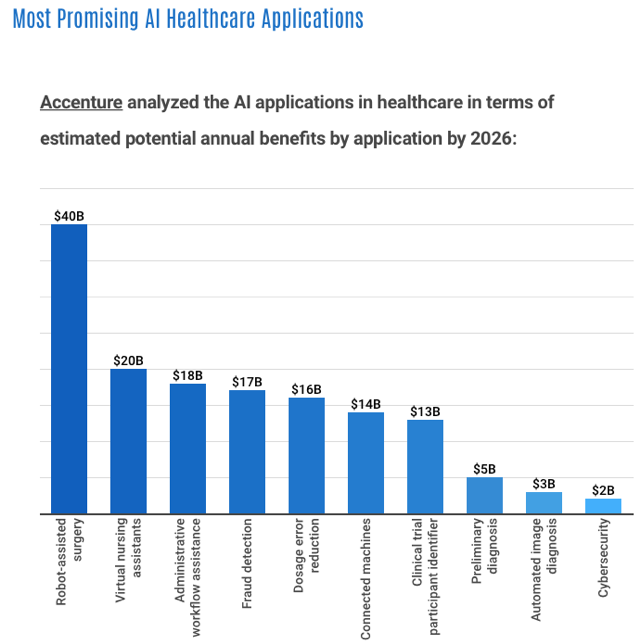
The healthcare industry generates a huge amount of physical and digital data. AI will allow to create a real structure to use them more efficiently which can reduce research costs.
Thanks to the development of digital consultation AI should help to cut down on unnecessary doctors’ visits which can reduce insurance expenses. (Schwartz, 2019)
WHAT ARE THE CHALLENGES OF IMPLEMENTING AI IN THE HEALTHCARE INDUSTRY?

Privacy and regulations:
Data must flow freely through AI systems to achieve real results. The problem is that extracting data from handwritten patient files or PDFs is difficult for AI. (Clark, 2018)
Furthermore, due to its confidential nature, healthcare data are usually restricted to the medical profession. For example, in European countries patient’s data are not allowed to leave Europe.
Transparency:
Doctors need to be able to understand and explain why a certain procedure was recommended by an algorithm. This necessitates the development of explanation tools.
Sociocultural:
Getting doctors to consider suggestions made by an automated system will be difficult because they are used to base their decisions on learned knowledge, previous experience or intuition. (Huss, 2018)
Andrew Beck, Director of Bioinformatics at Beth Israel Deaconess Medical Center Cancer Research Institute, said that the most effective deployments of AI in the healthcare industry are those that augmenthuman capabilities, not replace them. (Kritz, 2016)
That’s why we can say that AI will improve medical professionals and patients experience but it needs a real support from organizations to implement it.
HOW to implement AI IN THE HEALTHCARE INDUSTRY ESPECIALLY IN HOSPITALS?
The desired result of implementation of AI in hospitals will be a transformation, requiring shift in strategy, structures, systems, process & culture and will require a lot of investments. That’s why, the implementation should be incremental, it means that it should be made step by step.
In fact, skepticism from doctors is the main issue of implementing AI in the healthcare industry. That’s why organizational champions will need to prove their point with a pilot or well-defined program to reach doctor’s acceptance and hospitals should “start small” to implement AI in their organizations.
1) Support from the very highest levels of leadership:
First of all, governments should make the first move to help hospitals to implement AI.

Cédric Villani, a French mathematician and Member of the French Parliament made a report on March 2018 “Giving meaning to artificial intelligence” in which he identifies health sector as one of the 4 sectors
identified as a priority for AI deployment along with transport, defense and environment.
As such, to answer issues about data’s exploitation and protection, the French government has announced the launch of the “Health Data Hub”. This hub will be a unique platform allowing access to health data for startups, medtechs, researchers, companies and so on…(Millet, Institut Montaigne, 2019)
Before acting on a larger scale and affect all the organization, hospitals should first, deploy this new technology in a limited environment (for example radiology sector) to give them the chance to experiment, iterate, and solve problems.
Defining a “case-study” can help also help organizations to understand exactly what data they need and exactly what the resulting capabilities will be.
Steve Griffiths, PhD, Senior Vice President and Chief Operating Officer of Optum Enterprise Analytics made a great comparison between this strategy to adopt and Maslow’s pyramid :
“I like to compare it to Maslow’s hierarchy of needs: there are some basic skills you need to have before you can start to self-actualize.”
2) Designate champions and give them key roles across different departments :
In terms of role, health organizations should employed external consultant to implement AI. This consultant will advise and organize some trainings sessions to answer medical staff’s questions about the change. They will also convince medical staff that using AI could help them to move more quickly through complex cases and focus their time and effort on more challenging patients’ cases. (Bresnick, 2018)
3) Communicate clearly with stakeholders
Different styles of implementation can be used for various stakeholder groups. Concerning medical professionals in hospitals, the leaders should not use a directive or coercion style but more and educative and participative style. This style will help organizations to grow from a small AI system into a more long-term strategy for becoming a more data-driven organization.
Tim Durkin, a leadership and change management consultant and owner of Seneca Leadership Programs, has worked with several hospital administrators and he said that organizations should understand that confused people will not move. That’s why, hospitals need to communicate clearly to all kind of stakeholders. He also said that hospital leaders
should « Tell people the path that the change will take place » and show them that this change will save allow them to save time, effort and money. (Becker, 2011)

REFERENCES
Frost & Sullivan, 2015. From $600 M to $6 Billion, Artificial Intelligence Systems Poised for Dramatic Market Expansion in Healthcare.
Available at: https://ww2.frost.com/news/press-releases/600-m-6-billion-artificial-intelligence-systems-poised-dramatic-market-expansion-healthcare
Fei Jiang, Yong Jiang, Hui Zhi, Yi Dong, Hao Li, Sufeng Ma, Yilong Wang,Qiang Dong, Haipeng Shen, and Yongjun Wang, 2017. Artificial intelligence in healthcare: past, present and future
Available at : https://www.ncbi.nlm.nih.gov/pmc/articles/PMC5829945/
IBM Institute for Business Value, 2012. The value of Analytics in Healthcare
Laure Millet, Institut Montaigne, 2019.Artificial intelligence in health: how must healthcare professions adapt.
Available at : https://www.institutmontaigne.org/en/blog/artificial-intelligence-health-how-must-healthcare-professions-adapt
Thomas Gouritin, 2017. Rencontre avec la meilleure IA radiologue du monde
Available at: https://www.theconnectedmag.fr/intelligence-artificielle-radiologue/
Maastricht University Medical Center website : https://www.mumc.nl
Toby Nwazor, 2018, 5 Ways Artificial Intelligence May Affect Health Care in the Near Future and What That Means for You
Available at: https://www.entrepreneur.com/article/324578
Peter Schwartz, 2019.Why AI will make healthcare personal
Available at: https://www.weforum.org/agenda/2019/03/why-ai-will-make-healthcare-personal/
Charles Towers-Clark, 2018.Using Artificial Intelligence To Fix Healthcare
Available at: https://www.forbes.com/sites/charlestowersclark/2018/11/22/using-artificial-intelligence-to-fix-healthcare/#1392737d220c
Mikael Huss, 2018. Challenges of Implementing AI in healthcare.
Available at: https://peltarion.com/article/challenges-of-implementing-ai-in-healthcare
Jennifer Kritz, 2016. Artificial Intelligence Achieves Near-Human Performance in Diagnosing Breast Cancer
Available at: https://www.bidmc.org/about-bidmc/news/artificial-intelligence-achieves-near-human-performance-in-diagnosing-breast-cancer
Cédric Villani, 2017. For a Meaningful Artificial Intelligence
Available at: https://www.aiforhumanity.fr/pdfs/MissionVillani_Report_ENG-VF.pdf
Jennifer Bresnick, 2018.5 Steps for Planning a Healthcare Artificial Intelligence ProjectAvaible at: https://healthitanalytics.com/features/5-steps-for-planning-a-healthcare-artificial-intelligence-project
Becker, 2011.Shifting Cultures: A Change Management Guide for Hospital Leaders
Available at: https://www.beckershospitalreview.com/hospital-management-administration/shifting-cultures-a-change-management-guide-for-hospital-leaders.html
 Rennes Business Review
Hi Pauline,
According to you how will you convince the medical staff that AI could be business performance drivers? Don’t you think that they will see AI as a ‘ Job stealer ‘?
J’aimeAimé par 1 personne
Hello, Thank you for reading my article !
Healthcare industry is really complex and it evolving everyday, each patients cases are different. As I said, AI can reduce the complexity of some cases thanks to data storage for example. I don’t think that AI should be seen as « job stealer » but more as a support to medical professionals. For example, surgeons robots can not replace human surgeons but it can help them for some difficult operations and complex patients cases. Furthermore, doctors are really focus on previous experiences and AI can’t have this type of reflexion which can be very useful in some rare patients cases.
I hope I have answered to your question,
Best,
Pauline Leignel
J’aimeJ’aime
Hi Pauline, thank you for your article! It covers very well the challenges AI will solve in the healthcare industry. You talked about radiology and AI, you should have a look on Azmed : https://www.azmed.co/. It is a startup I worked with at @TechtarsParis, they developed a powerful algorithm to assist radiologists in their diagnostics. 😀
J’aimeAimé par 1 personne
Hello Chloé,
Thank you for reading my article and for your comments !
Have a good day
J’aimeJ’aime